Unit 4, Sample Trade Park, Gateshead
Serviceable, two priority repairs
The roof is intact but tired, and it is not draining as it should. The two items to act on are linked: a blocked outlet is backing water up, and the standing water it leaves is sitting over a split in the membrane. Clear the drain and seal the split and you take the live ingress risk off the table; the rest is planned maintenance to get the falls and the rooflight details back in order.
 1
2
3
4
5
1
2
3
4
5
Findings
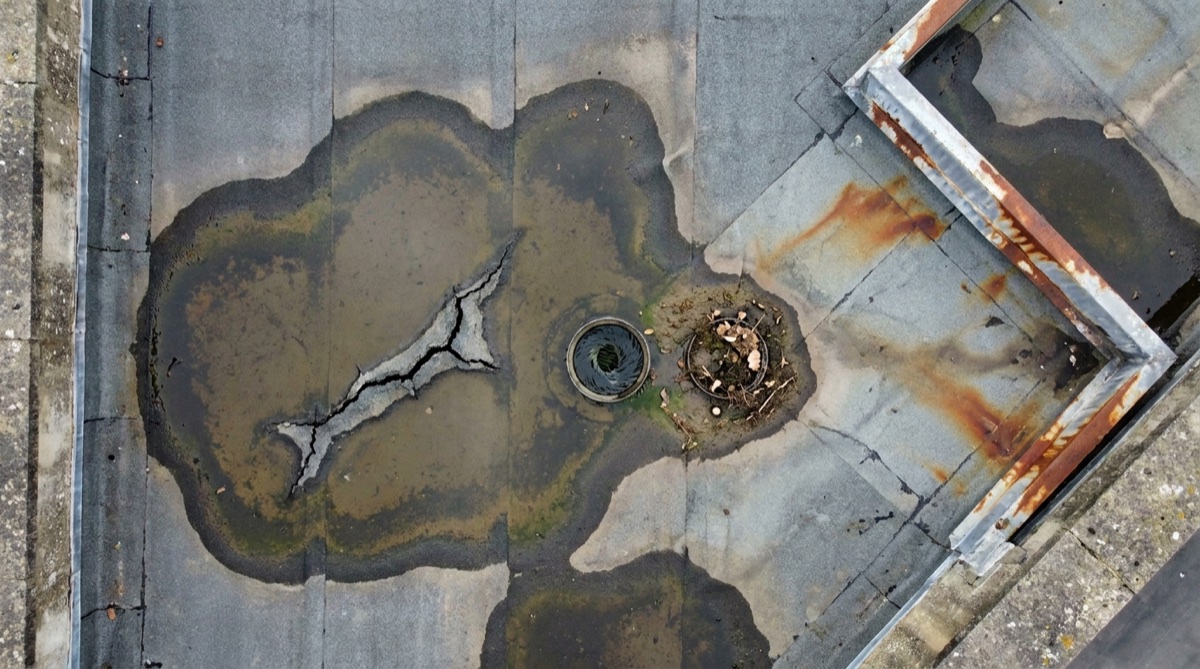
Five items recorded across the main roof field. Each is located on Figure 1 and graded by how soon it needs attention, not by how it looks.
Ponding water — large standing areas Amber
Broad areas of standing water and tide-marking show the roof is not clearing after rain — the falls are shallow or the deck has settled. Long-term ponding is the single biggest ager of a flat roof: it breaks down the membrane, grows organic matter and adds weight. It is the symptom; findings 2 and 3 are the cause.
Recommended: once the outlet is cleared (3), re-check whether water clears. Where it still ponds, plan tapered insulation or an additional outlet to restore the falls.
Membrane split — within the ponding zone Red
A crack/split runs through the membrane in the lowest part of the roof — exactly where the water sits longest. A split under standing water is a direct route into the insulation and deck below, and it is the most likely source of any internal damp at this end of the unit.
Recommended: cut out and patch the split with a bonded/welded repair to match the existing system, then check the deck around it is still sound.
Outlet — blocked with debris Red
One of the two outlets is silted up and ringed with debris, so it is no longer taking water — which is why the field is ponding. A blocked outlet on a flat roof also forces water sideways to find any weak point, and the nearest weak point here is the split at finding 2.
Recommended: clear the outlet and the leaf-litter around it, fit a domical guard, and check the downpipe below runs free. Quickest, cheapest job here and it unlocks the ponding problem.
Second outlet — clear & running Green
The adjacent outlet is open and running freely, which is why the right of the field is in better shape than the left. Recorded here as the benchmark — this is how the blocked one (3) should look once cleared.
Recommended: no action; add to the same gutter-and-outlet clearing round as the rest.
Rooflight kerb — corroded flashing Amber
The metal flashing capping the rooflight kerb is rusting and staining the membrane below it. Upstands and rooflight details are the usual failure points on a flat roof — water gets in at the join long before the open field gives way.
Recommended: treat or replace the corroded flashing and reseal the upstand-to-membrane junction. Inspect the other rooflight kerbs at the same time.
What we'd do, in order
- Now — clear the blocked outlet (3) and seal the membrane split (2). Together these stop the active ingress route and let the roof drain again.
- Next — with the roof draining, re-assess the ponding (1) and price tapered insulation or an extra outlet where water still stands; treat the corroded rooflight flashing (5).
- Ongoing — add the outlets and upstands to a twice-yearly clearing and check round (4). On a flat roof, blocked drainage is what turns a £100 job into a re-cover.
Scope & limitations
This is an external visual inspection carried out by drone. It records the visible condition of the roof covering, outlets, upstands, rooflights and flashings from the air on the date of survey. It is not a structural survey, a measured falls survey, or a guarantee of watertightness, and it does not assess anything not visible from above — the deck, insulation, internal leaks, or anything beneath the membrane. Findings and gradings are the surveyor's professional opinion from the imagery and are intended to help you prioritise repairs and brief a roofer or maintenance contractor; they are not a quote for works. Where a defect is graded Red or carries a leak risk, we recommend a contractor inspects at close quarters before work. This sample uses illustrative imagery and does not relate to a real property.
North of England · Borders · Scotland
Call us · Dave@forged40.com · forged40.com