14 Sample Terrace, Hexham
Sound roof, one priority repair
The main tile covering is serviceable with normal age-related wear. The defects worth acting on are concentrated at the chimney: the flashing has failed and is under a temporary covering, which is an active water-ingress risk and the one item we'd treat as urgent. The remaining findings are routine maintenance best dealt with in the same visit while access is set up.
 1
2
3
4
5
1
2
3
4
5
Findings
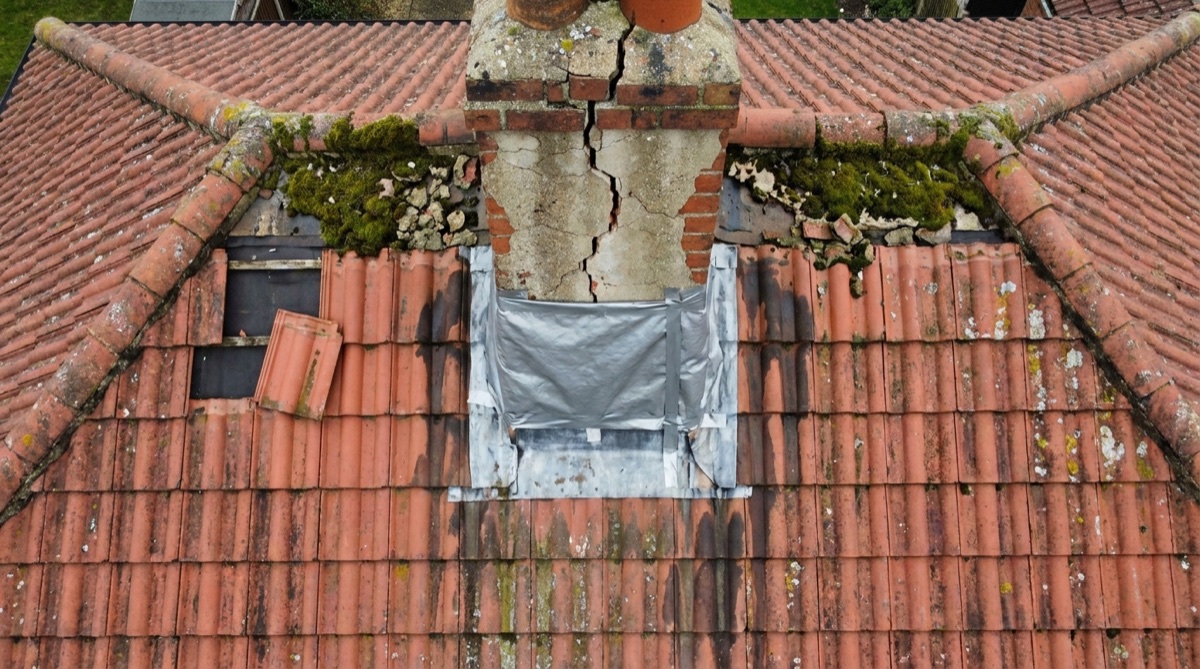
Five items recorded on this slope. Each is located on Figure 1 and graded by how soon it needs attention, not by how it looks.
Chimney render — spalled face & vertical crack Amber
The cement render on the stack has blown and is spalling on the upper face, with a vertical crack running down toward the flaunching. Water is getting into the stack rather than running off it. Left alone this accelerates the mortar erosion below and can show as damp on the chimney breast inside.
Recommended: hack off and re-render the stack, and renew the flaunching to the pots, while access is in place for finding 2.
Chimney flashing — failed, temporary covering in place Red
The lead flashing and soakers at the junction have failed and a temporary sheet covering has been taped over the gap. This is the most exposed joint on the roof and it is currently relying on a stop-gap. Any wind-driven rain is tracking straight into the junction — this is where a leak shows up at the ceiling below.
Recommended: strip the temporary covering and re-dress the junction in new lead — step flashing and soakers, properly dressed and pointed. This is the priority job.
Back gutter — moss build-up & fallen mortar Amber
The back gutter behind the stack is choked with moss and holds loose mortar that has dropped from the joints above. A blocked back gutter dams water against the stack — exactly the spot already weakened by findings 1 and 2.
Recommended: clear the back gutter, remove organic growth and check the lead beneath is sound and lapped correctly.
Slipped tile — mid-slope, left Amber
One tile has slipped out of course, exposing the underlay and breaking the wind seal of the tiles around it. On its own it is a small job — but in a gale a single slipped tile is the usual start of a wind-uplift problem, once that seal is gone.
Recommended: re-bed and re-secure the tile, and check the nibs/clips on the immediately surrounding tiles.
Tile surface — general lichen & moss Green
Widespread surface lichen and light moss across the covering. This is cosmetic at the moment and normal for the roof's age and a north-facing aspect. It is worth keeping an eye on because heavy moss eventually blocks the tile interlocks and holds water, but nothing here needs action today.
Recommended: no action now; a soft-wash every few years keeps it in check. Avoid pressure-washing, which strips the tile surface.
What we'd do, in order
- Now — re-dress the chimney flashing in new lead (finding 2). This is the only item carrying a live leak risk.
- Same visit — while access is up, re-render the stack and renew the flaunching (1), clear the back gutter (3) and re-bed the slipped tile (4). Doing these together saves a second set-up.
- Ongoing — soft-wash the covering on a few-year cycle and monitor the moss (5).
Scope & limitations
This is an external visual inspection carried out by drone. It records the visible condition of the roof covering, chimney, flashings and rainwater detail from the air on the date of survey. It is not a structural survey, a RICS Home Survey, or a guarantee of watertightness, and it does not assess anything not visible from above — roof timbers, the underlay, insulation, internal leaks, or anything beneath the covering. Findings and gradings are the surveyor's professional opinion from the imagery and are intended to help you prioritise repairs and brief a roofer; they are not a quote for works. Where a defect is graded Red or carries a leak risk, we recommend a roofer inspects at close quarters before work. This sample uses illustrative imagery and does not relate to a real property.
North of England · Borders · Scotland
Call us · Dave@forged40.com · forged40.com