Manor Farm steading, Wooler
A working roof near the end of its life — and one nobody should walk
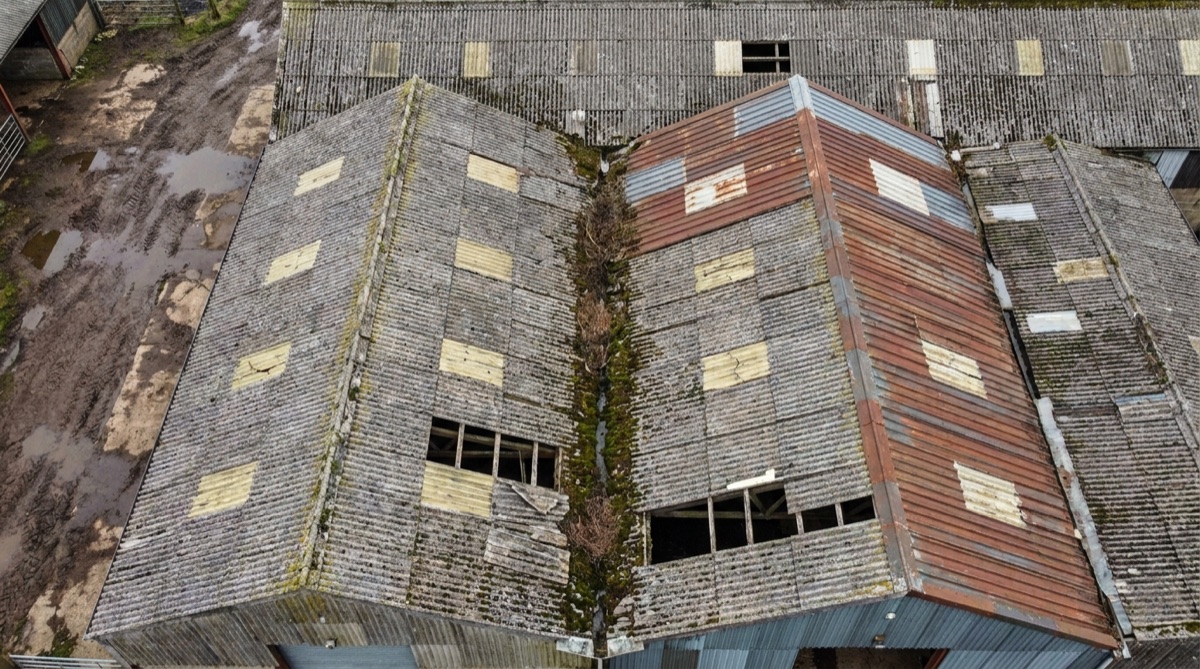
This roof is doing its job but it's tired, and two things need dealing with now: a valley gutter that's completely blocked, and open holes where sheets have gone. Two bigger points sit over the whole survey. First, the grey sheets are very likely asbestos-cement given the age (to be confirmed by survey) — fine left alone, but a legal duty to manage and not something to disturb. Second, between the asbestos, the brittle rooflights and the open holes, this is a fragile roof: a fall through one is the single biggest killer on farm roofs, and it's exactly why this was flown, not walked. You've got the whole picture without anyone setting foot on it.
 1
2
3
4
5
1
2
3
4
5
Findings
Five items recorded across the two bays. Two need dealing with now; the other three are the bigger-picture calls on asbestos, fragility and re-sheeting.
Valley gutter — blocked, with a sapling growing in it Red
The valley gutter running between the two bays is choked with moss, leaves and a self-seeded sapling — it has been blocked long enough for a tree to take hold. This is the main drainage line for two entire roof slopes, and right now it isn't carrying anything.
Recommended: clear the valley fully, remove the sapling and its roots, and check the gutter lining and laps underneath once it's clear.
Broken & missing sheets — open holes Red
Several sheets and rooflights are broken or missing, leaving open holes straight into the building. Two separate problems: water and weather landing on whatever's stored below, and — the serious one — a roof you cannot safely stand on anywhere near them.
Recommended: sheet over or barrier off the holes, and until the roof is re-sheeted treat the whole thing as fragile — no foot traffic, inspections by drone only.
Fibre-cement sheets — manage as asbestos Amber
The grey corrugated sheets are fibre-cement, and on a building of this age they are very likely asbestos-cement. Weathering in place they are low-risk and don't need ripping off in a panic — but you have a legal duty to manage them, and any work that breaks, drills, cuts or removes them is licensed work, not a DIY job.
Recommended: have the sheets confirmed by an asbestos survey and put on a written management plan; treat as asbestos until proven otherwise.
On a farm roof: don't walk, drill or pressure-wash these sheets — a drone survey is exactly how you inspect them without disturbing them.
GRP rooflights — degraded & brittle Amber
The translucent rooflight sheets are yellowed, crazed and brittle. They've stopped letting useful light in, and — like the broken sheets — they will not take a person's weight. Old rooflights are the classic fall-through trap because from on the roof they look just like the sheets around them.
Recommended: plan to replace with modern non-fragile rooflights (to the ACR fragility standard) next time the roof is accessed.
Box-profile steel — corroding Amber
The steel sheets on the far bay are rust-streaked and corroding — and if this is or was a livestock building, the ammonia will have eaten the coating from the underside faster than the weather did from the top. Once it perforates you get leaks, and the fixings loosen, which is where the wind gets a hold.
Recommended: over-sheet or replace the corroding bay; tighten or renew loose fixings as an interim.
What we'd do, in order
- Now — clear the blocked valley (1) and make the open holes safe (2). That stops the water going inside and takes the immediate fall risk off the table.
- Plan — get the fibre-cement confirmed and on an asbestos management plan (3), budget to replace the brittle rooflights with non-fragile ones (4), and over-sheet or replace the corroding steel bay (5).
- Safety & opportunity — until it's re-sheeted, the whole roof is fragile: no foot traffic, drone-only inspection. And if you're re-sheeting anyway, that's the moment to assess these spans for solar PV — the orientation here could carry it.
Scope & limitations
This is an external visual inspection carried out by drone. It records the visible condition of the roof sheeting, valleys, rooflights, ridges and fixings from the air on the date of survey. It is not an asbestos survey — where asbestos-cement is suspected we say so and recommend a formal asbestos survey by a competent surveyor; nothing here confirms or clears the presence of asbestos. It is not a structural survey or a guarantee of watertightness, and it does not assess anything not visible from above — the frame, purlins, internal condition or anything beneath the sheets. The roof should be treated as fragile and not walked. Findings and gradings are the surveyor's professional opinion from the imagery, intended to help you prioritise and brief a contractor; they are not a quote for works. This sample uses illustrative imagery and does not relate to a real property.
North of England · Borders · Scotland
Call us · Dave@forged40.com · forged40.com