St Oswald's, Alnwick
Typical listed-roof wear — two water routes to close, with heritage care
The roof is original and has been patched over the years rather than overhauled. None of it has failed, but two details are letting water into the fabric — the lead valley and the parapet gutter — and on a building like this, water in the fabric is how you end up with rotten historic timber and spalled stone, not just a stain. The repairs are routine for a heritage roofer, but every one of them needs the right material and the right consent: lead, lime and matched stone, not membrane, cement and concrete. The drone matters here — nobody has to put a ladder against fragile stone or walk a lead roof to get this.
 1
2
3
4
5
1
2
3
4
5
Findings
Five items recorded. Two are letting water in now; three are heritage-maintenance items to do with the same access and the same consent.
Lead valley — fatigue rippling & cracking Red
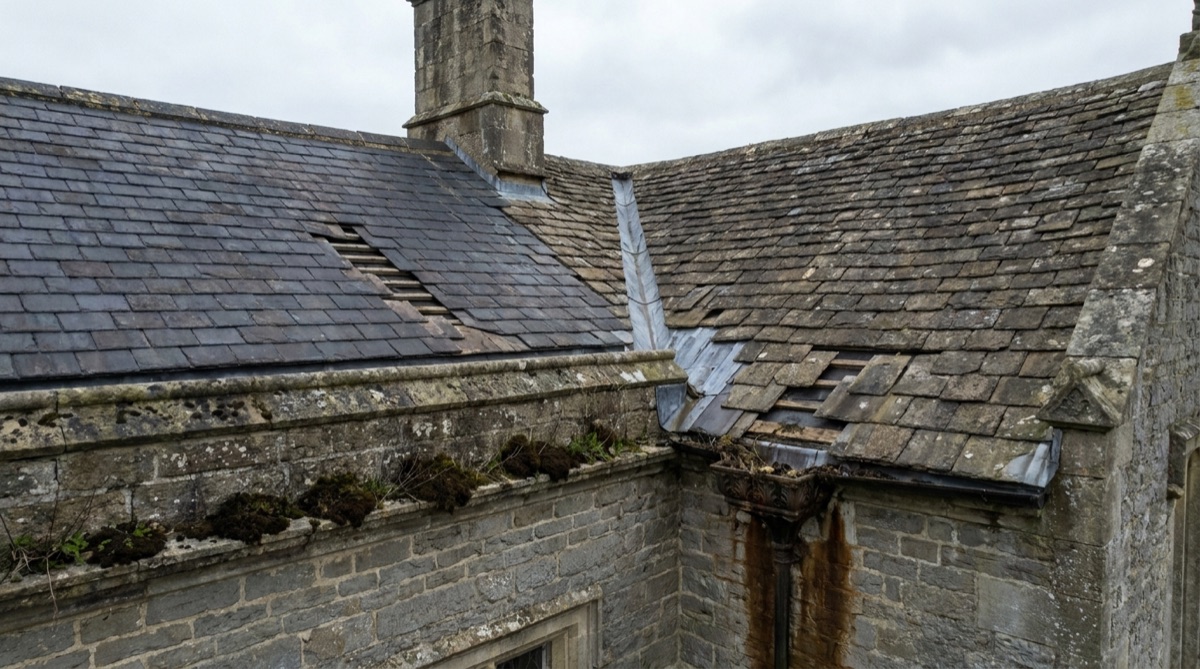
The lead in the main valley is rippled and has been patched. That rippling is thermal-movement fatigue — over-long lead bays that haven't been able to expand and contract, so the lead has crept and is now splitting at the worst point, where all the water from both slopes funnels through.
Recommended: re-lay the valley in new lead in correct bay lengths to a Lead Sheet Association detail.
Heritage care: re-lay in lead, not a modern membrane or sealant patch — and the work needs listed-building consent before it starts.
Parapet gutter — moss & self-seeded weeds Red
The parapet gutter behind the coping is colonised with moss and self-seeded weeds, holding water along the wall head. Parapet gutters are the hidden high-risk detail on a building like this — out of sight behind the parapet, and when they overflow they fail inward, into the structure, not over the edge where you'd see it.
Recommended: clear the gutter by hand, check the lead lining and outlets beneath, and put it on a scheduled clear-out.
Before any work: take ecological advice first — nesting birds and roosting bats are legally protected, we do not assess for them, and disturbing them can be a criminal offence.
Stone slates — slipped on the left slope Amber
Several heavy stone slates have slipped out of course, exposing the battens and underlay. The likely cause at this age is nail sickness — the iron fixings have corroded through — so where one or two have gone, more will follow. A slipped stone slate is also a real falling hazard to anyone at the eaves below.
Recommended: re-fix the slipped slates and spot-check the surrounding fixings; if nail sickness is widespread, plan a phased re-fix of the slope.
Heritage care: re-fix or replace like-for-like in matched/salvaged stone slate — not concrete or mismatched reclaim.
Cast-iron hopper & downpipe — blocked & corroding Amber
The cast-iron hopper is corroding and overflowing — you can see the rust and damp streaking the stone wall directly below it. The water that should be going down the pipe is going down the wall instead.
Recommended: clear the hopper and downpipe, then descale and repaint the cast iron to arrest the corrosion.
Heritage care: cast iron is repairable and worth keeping — don't swap it for uPVC on a listed elevation.
Lime pointing & coping — eroded Amber
The mortar to the parapet coping and stonework is eroded and open in places, so the head of the wall is taking water straight into the core. On a solid stone wall this is slow but cumulative — and it is the kind of thing that is cheap now and expensive once the stone faces start to go.
Recommended: rake out the failed joints and repoint the coping and open beds while the access is up for findings 1 and 2.
Heritage care: repoint in matched lime mortar, never cement — cement traps water in the wall and blows the stone face off in frost.
What we'd do, in order
- Now — re-lay the lead valley (1) and clear and overhaul the parapet gutter (2). These are the two routes putting water into the historic fabric.
- Same access — re-fix the slipped stone slates (3), descale and repaint the cast-iron goods (4), and repoint the coping in lime (5). One scaffold/access set-up covers all five.
- Consents & cycle — agree the repairs with the conservation officer (and the faculty/DAC if this is a church) before work starts, check for protected birds and bats first, and keep the roof in its quinquennial cycle so this report becomes the dated baseline.
Scope & limitations
This is an external visual inspection carried out by drone. It records the visible condition of the roof covering, leadwork, valleys, parapet gutters, chimney, rainwater goods and stonework from the air on the date of survey. It is not a structural survey, a measured condition survey, a guarantee of watertightness, or a formal quinquennial inspection — though it gives a conservation surveyor a detailed, dated head start on one. It does not assess anything not visible from above — roof timbers, the underlay, internal leaks, or anything beneath the covering — and any heritage repair will need the appropriate listed-building or ecclesiastical consent before work begins. Findings and gradings are the surveyor's professional opinion from the imagery, intended to help you prioritise and brief a conservation-accredited contractor; they are not a quote for works. This sample uses illustrative imagery and does not relate to a real property.
North of England · Borders · Scotland
Call us · Dave@forged40.com · forged40.com